
Everyone knows those little candies, the ones you might have as a snack between meals or in the evening. Candy comes in just about every form imaginable. There are fruit-flavored gummy candies, which can be sweet or sour, as well as chocolate paired with cookies or fruit. They come in a wide variety of types and blends. However, to ensure that these popular snacks and candies are always available in stores, appropriate pouch packaging is necessary.
The primary requirements for primary packaging are low packaging costs and high product protection. During filling, it is essential to minimize product breakage, in baked goods for example, and to prevent clumping during dispensing of soft products, such as fruit gummies. Our goal is to produce perfect pouches at the lowest possible unit cost, reliably throughout the entire service life of the machine.







High flexibility
for a huge variety of products
We are familiar with confectionery and snacks in every conceivable form and variety. From sweet or salty to chocolatey and fruity. Primary packaging is very important for providing the best possible protection for the products and extending their shelf life. It protects the product from external factors while also serving as a visible advertising space for the product. The wide variety of product variants and characteristics requires a flexible and easy-to-use packaging machine. Multihead weighers are typically used for packaging snacks and confectionery. They combine the target weight from several independent load cells and transmit it to the packaging machine at precisely the right moment.
Gentle and smooth product filling
with custom configurations
of the dosing systems To ensure reliable filling, it is essential that particularly soft products, such as fruit gummies, do not stick. This maintains a continuous flow of product. In this case, parts that come into contact with the product typically have particularly smooth and slippery surfaces. When handling particularly fragile products, such as pastries or glazed confectionery, product breakage must be minimized at all costs. For example, to achieve this, gentle, soft flaps are installed to reduce the drop height and cushion the impact.


Our machines are designed for quick and easy format changes and maximum flexibility in day-to-day production. Our machines enable partly tool-free format changeovers in less than 15 minutes, depending on the machine type. The integrated recipe management system automatically loads and sets all relevant process parameters – ensuring error-free changeovers, minimal downtime, and maximum efficiency during product and format changes. This results in higher machine availability and, consequently, a significantly higher output per year.

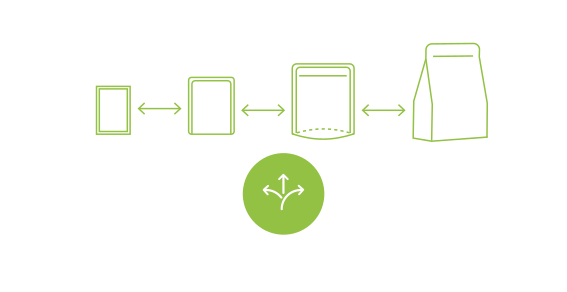
Wide range of pouch formats and filling volumes
Our machines can produce and fill flat pouches, stand-up pouches, and pre-made side gusset pouches. In addition, of course it is possible to seal in a resealable closure, such as a zipper or slider. Our machines can fi ll a wide range of filling weights.
Compact design thanks to the rotary system
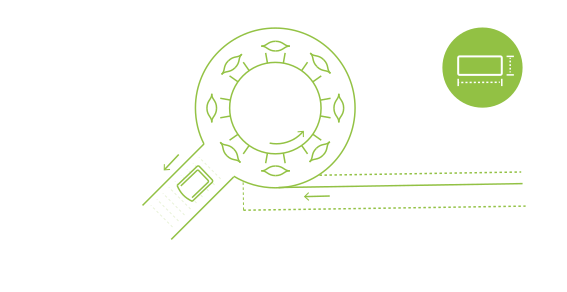
We have always specialized in horizontal rotary pouch machines (HFFS). This machine design requires little floor space in the production area, particularly because it operates on a circular path. We offer pouch packaging machines with integrated dosing systems starting at a footprint of 20 m².


High-quality products deserve premium pouch quality
What matters when designing a pouch:
Stand-up bottom
An additional fold in the packaging material creates a pouch's stand-up base. This very stable base construction enables the pouch to stand independently on a flat surface. In addition to the primary function of being able to stand on its own, the stand-up bottom and the resulting bottom fold give the pouch a higher filling volume than a flat pouch. The bottom shape can usually be round, as in doypacks, or trapezoidal, as in deltapacks.
Zipper
A so-called zipper reclosure is often used to make the pouch reclosable. This zipper consists of two plastic lips that can be pressed together, pulled apart, and sealed into the top area of the pouch. This makes it possible to reclose the pouch after it has been opened for the first time and maintain the filling product's freshness to a certain extent.
Tear opening notch
The tear-opening notch is a punched hole in the upper side seal seam of the pouch. This punching makes it easier for the consumer to tear open the pouch without tools and consume the contents. The tear-opening notch is usually designed as an incision or punched-out arrowhead.
Side sealing seam
The side sealing seam is the two sealed pouch edges and closes it in this area. The side sealing seam requires exceptional quality and strength. Its width can be freely selected according to the length of the pouch. Depending on the contents, filling quantity, and size, the pouch must be able to withstand various pressures and sealing requirements. Optical and functional sealing patterns, such as cross and ripple patterns, can also be created in the sealing seam.
Top sealing seam
A top sealing seam permanently closes the pouch after filling. The side sealing seam requires exceptional quality and strength. Depending on the contents, filling quantity, and size, the pouch must be able to withstand various pressures and tightness requirements. In addition to the technical requirements, wider top sealing seams are often produced to give the pouch a corresponding appearance. Additional functions like hanging devices (euro hole or round hole) are integrated into the top seam.
Sealing seam quality
Sealing seam quality is one of a pouch core criteria. It must meet a wide range of quality and functional criteria. Thanks to our innovative and high-quality sealing technology, our machines can guarantee consistently high sealing seam strength over the long term. This also applies to different packaging materials and mono-materials.
Processability of mono-materials
All of our new machines can process recyclable mono-materials as standard. Thanks to innovative unwinding and sealing technology, new and thinner films and papers can be processed at the same quality and speed.
Filling level
To minimize packaging material and costs, but also from a sustainability perspective, keeping the space between the product fill level and the top seam as small as possible is essential. Some technical processes, such as tightening before head sealing, require a certain amount of space in the headspace of the pouch. Headspace steaming, intended to counteract possible pouch inflation, also requires a certain amount of free space in the head area of the pouch. We are happy to help with the optimum design of the pouch dimensions depending on the intended filling quantity and filling level.
Overview of common pouch details
Details that really matter
-
Stand-up bottom
An additional fold in the packaging material creates a pouch's stand-up base. This very stable base construction enables the pouch to stand independently on a flat surface. In addition to the primary function of being able to stand on its own, the stand-up bottom and the resulting bottom fold give the pouch a higher filling volume than a flat pouch. The bottom shape can usually be round, as in doypacks, or trapezoidal, as in deltapacks.
-
Zipper
A so-called zipper reclosure is often used to make the pouch reclosable. This zipper consists of two plastic lips that can be pressed together, pulled apart, and sealed into the top area of the pouch. This makes it possible to reclose the pouch after it has been opened for the first time and maintain the filling product's freshness to a certain extent.
-
Tear opening notch
The tear-opening notch is a punched hole in the upper side seal seam of the pouch. This punching makes it easier for the consumer to tear open the pouch without tools and consume the contents. The tear-opening notch is usually designed as an incision or punched-out arrowhead.
-
Side sealing seam
The side sealing seam is the two sealed pouch edges and closes it in this area. The side sealing seam requires exceptional quality and strength. Its width can be freely selected according to the length of the pouch. Depending on the contents, filling quantity, and size, the pouch must be able to withstand various pressures and sealing requirements. Optical and functional sealing patterns, such as cross and ripple patterns, can also be created in the sealing seam.
-
Top sealing seam
A top sealing seam permanently closes the pouch after filling. The side sealing seam requires exceptional quality and strength. Depending on the contents, filling quantity, and size, the pouch must be able to withstand various pressures and tightness requirements. In addition to the technical requirements, wider top sealing seams are often produced to give the pouch a corresponding appearance. Additional functions like hanging devices (euro hole or round hole) are integrated into the top seam.
-
Sealing seam quality
Sealing seam quality is one of a pouch core criteria. It must meet a wide range of quality and functional criteria. Thanks to our innovative and high-quality sealing technology, our machines can guarantee consistently high sealing seam strength over the long term. This also applies to different packaging materials and mono-materials.
-
Processability of mono-materials
All of our new machines can process recyclable mono-materials as standard. Thanks to innovative unwinding and sealing technology, new and thinner films and papers can be processed at the same quality and speed.
-
Filling level
To minimize packaging material and costs, but also from a sustainability perspective, keeping the space between the product fill level and the top seam as small as possible is essential. Some technical processes, such as tightening before head sealing, require a certain amount of space in the headspace of the pouch. Headspace steaming, intended to counteract possible pouch inflation, also requires a certain amount of free space in the head area of the pouch. We are happy to help with the optimum design of the pouch dimensions depending on the intended filling quantity and filling level.
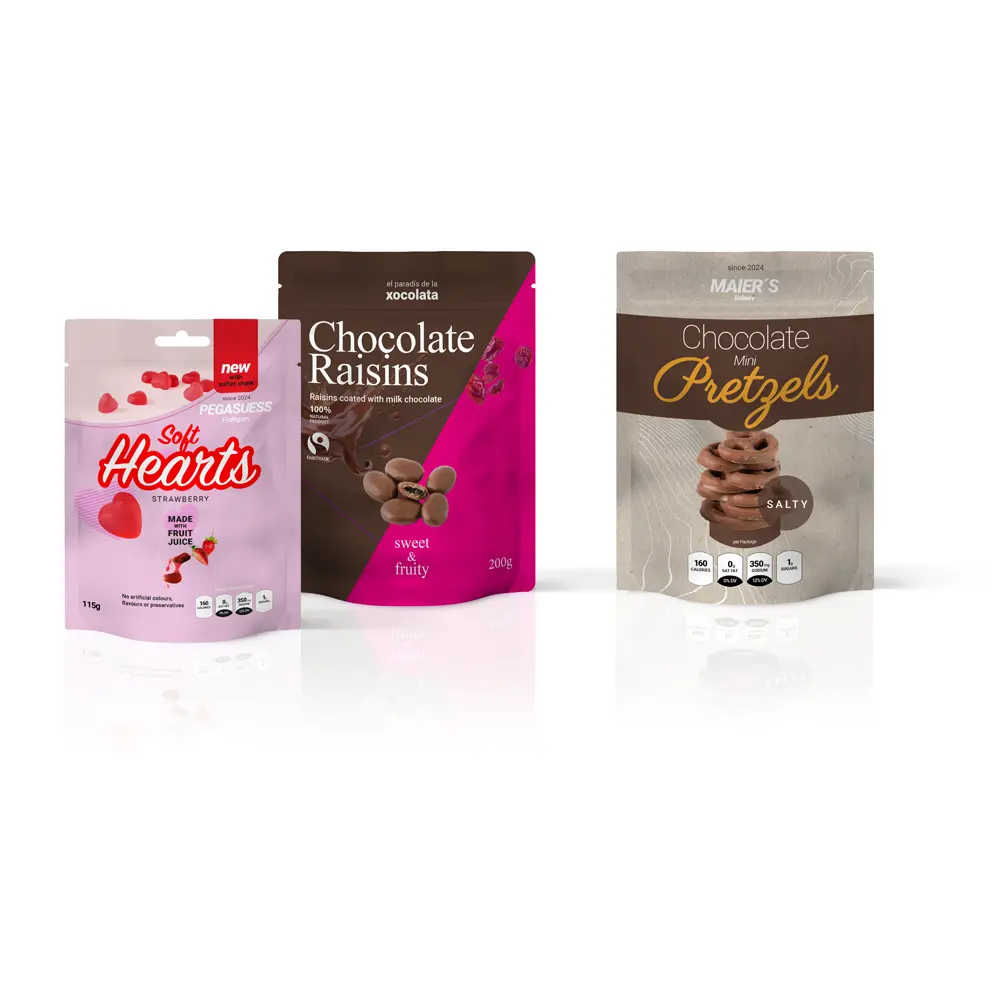

We are happy to support you in your pouch packaging project with customized machine and dosing technology.
We look forward to your inquiry.
Phone: +49 2267 699-0
Email: sales@sn-packaging.de


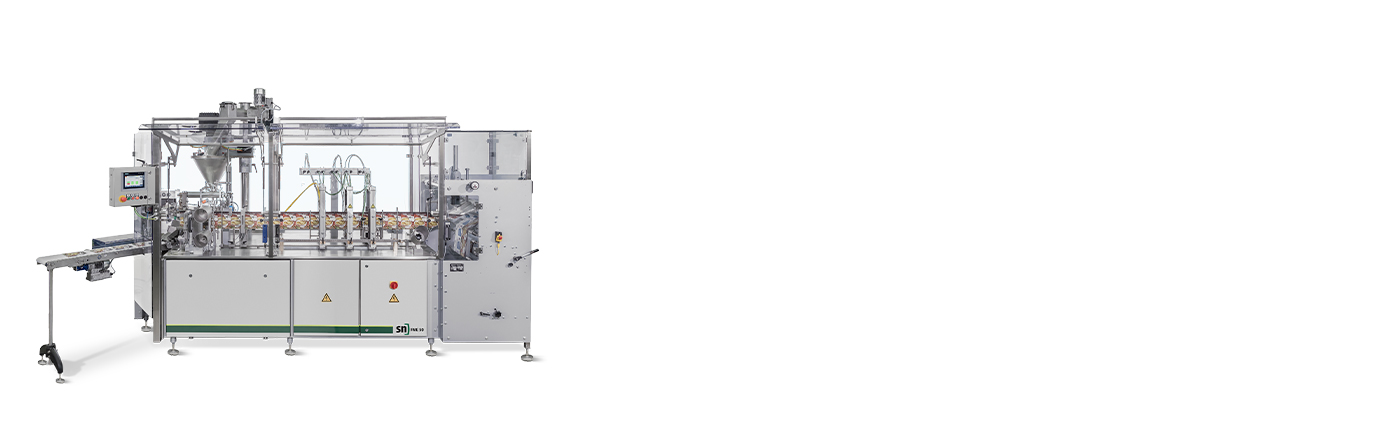
FME 50
Horizontal form, fill and seal machine (HFFS)
Format range pouch width
50 – 170 mm
Format range pouch height
70 – 210 mm
Realistic output rate
up to 70 pouches/min.
Exemplary yearly production output (single shift)
about 7 million pouches
(Data dependent on filling properties, pouch size, and production times)
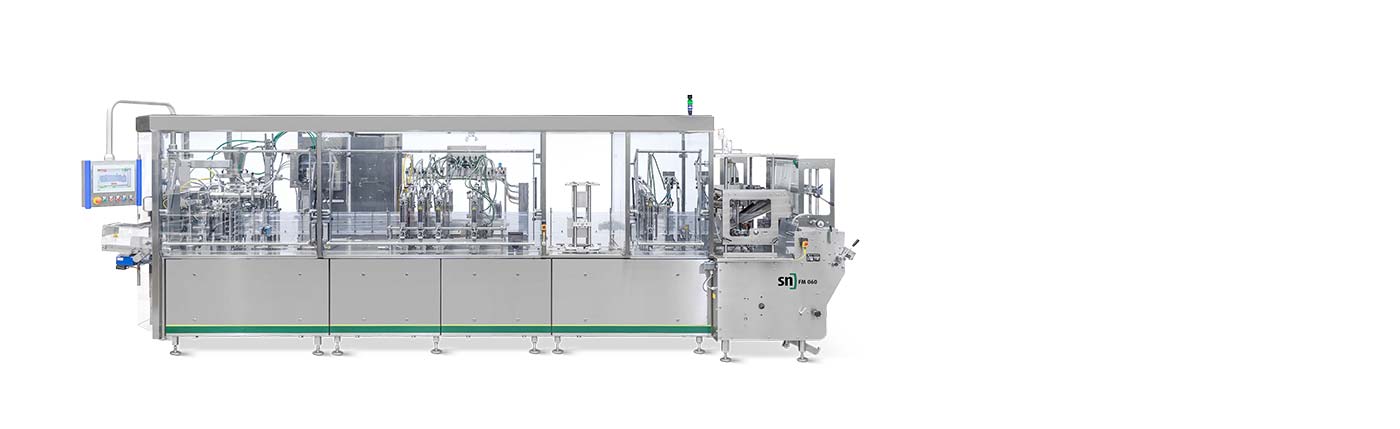
FM 060
Horizontal form, fill and seal machine (HFFS) simplex
Format range pouch width
40 – 220 mm
Format range pouch height
50 – 250 mm
Realistic output rate
up to 70 pouches/min.
Exemplary yearly production output (single shift)
about 7.5 million pouches
(Data dependent on filling properties, pouch size, and production times)
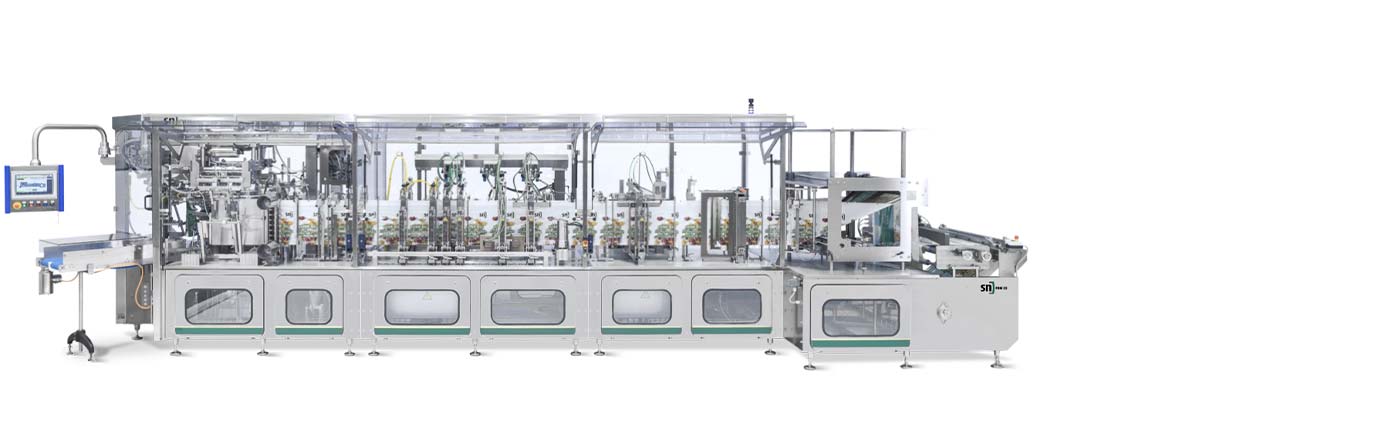
FBM 22
Horizontal form, fill and seal machine (HFFS) duplex
Format range pouch width
120 – 190 mm
Format range pouch height
100 – 450 mm
Realistic output rate
up to 140 pouches/min.
Exemplary yearly production output (single shift)
about 45 million pouches
(Data dependent on filling properties, pouch size, and production times)

Contact
We are happy to support you in your pouch packaging project with customized machine and dosing technology.
We look forward to your inquiry.
Phone: +49 2267 699-0
Email: sales@sn-packaging.de