
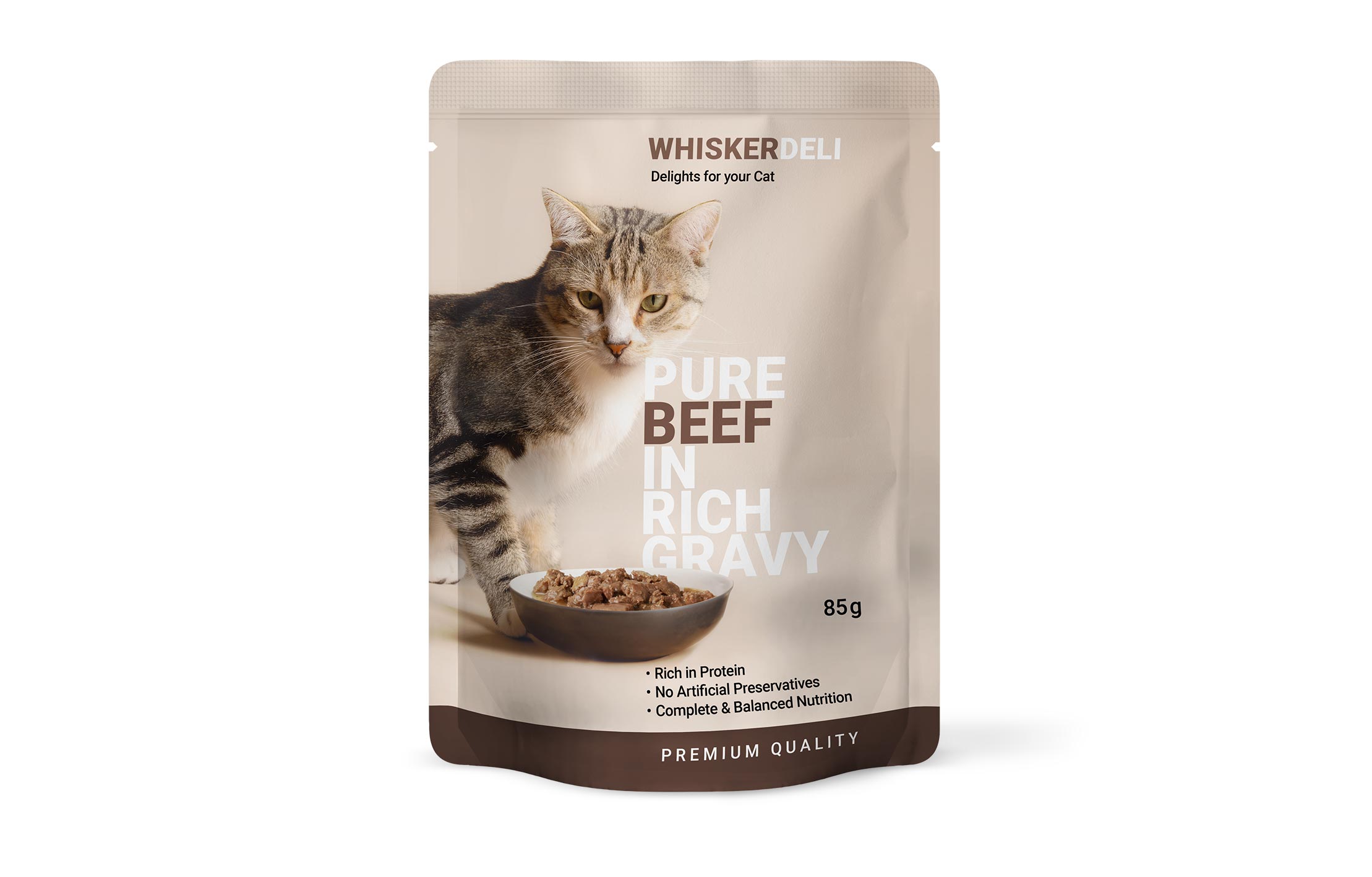
In order to fill and package wet pet food safely and cost-effectively, the pouch packaging machine must meet very high standards. Usually, two types of products are packaged in the pouch. Firstly, the meat chunks, and secondly, the gravy. The demands on the film and the quality of the sealing are particularly high for retort pouches, since the pouch must be autoclaved after being manufactured, filled and sealed. To do this, any remaining air is removed from the pouch by steam before the top is sealed.
We develop, manufacture, and provide customized and highperformance pouch packaging technology for wet pet food. Our machines combine the highest quality standards with precise dosing technology and maximum speed. Our goal is to produce perfect pouches at the lowest possible unit cost, reliably throughout the entire service life of the machine.







High output rates
with the integration of various additional components
Packaging wet pet food requires a perfect interplay of many individual processes. Together with multihead weighers and our in-house dosing pumps, our machines achieve the highest speeds with high dosing accuracy. Thanks to our many years of experience in the packaging of wet pet food, we offer leading and economical packaging technology in this sector.
Top pouch quality
through the use of innovativesealing technologies
The requirements for packaging wet pet food in retort pouches are particularly high. This means that the fi lm must offer both exceptional barrier properties and excellent sealing seam quality. In addition to being filled in a high-humidity environment, the product is filled into the pouch in two steps. The pouches are then steam-treated to force out of residual air left inside. To ensure a completely leak-proof top sealing, we use ultrasonic sealing. In this process, both sealing seams – the functional and cosmetic seams – are produced using a dual-sealing tool. Once the wet pet food has been packaged, the pouches are typically autoclaved at a temperature of 121°C under pressure.


Integration of all machine components into a central HMI
The number of additional machines and components involved in packaging wet food is high. This allows all key components and functions, such as dosing and ultrasonic sealing, to be integrated centrally into the machine control panel (HMI). This makes it much easier to operate and monitor production-related data and machine components.


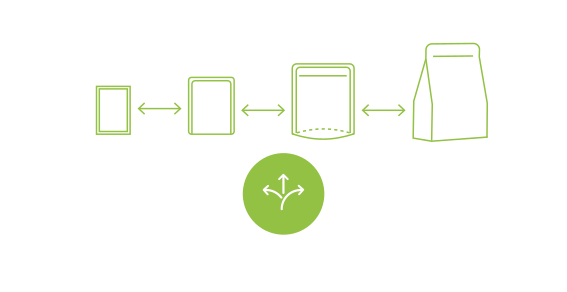
Quick and easy format changes
Depending on the format and machine type, format changes can be completed in just a few minutes, and in some cases without tools. Using the integrated recipe management system, production and machine parameters for individual products and formats can be easily loaded automatically via the control panel (HMI). Short setup and product changeover times significantly reduce machine downtime, ultimately leading to higher machine utilization and increased productivity.
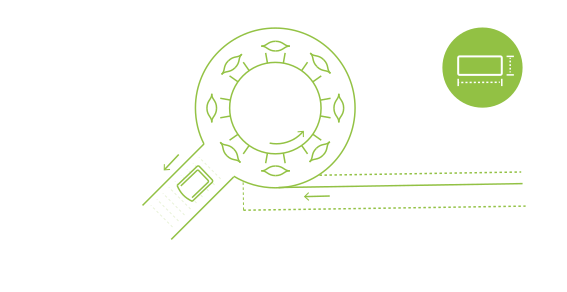
Compact design thanks to the rotary system
We have always specialized in horizontal rotary pouch machines (HFFS/HFS). This machine design requires little floor space in the production area, particularly because it operates on a circular path. We offer pouch packaging machines with integrated dosing systems starting at a footprint of 20 m². The space-saving advantages of our rotary pouch machines are becoming increasingly apparent, especially in multi-station machines.
High-quality products deserve premium pouch quality
The essence of designing a pouch

Stand-up bottom
An additional fold in the packaging material creates a pouch's stand-up base. This very stable base construction enables the pouch to stand independently on a flat surface. In addition to the primary function of being able to stand on its own, the stand-up bottom and the resulting bottom fold give the pouch a higher filling volume than a flat pouch. The bottom shape can usually be round, as in doypacks, or trapezoidal, as in deltapacks.
Tear opening notch
The tear-opening notch is a punched hole in the upper side seal seam of the pouch. This punching makes it easier for the consumer to tear open the pouch without tools and consume the contents. The tear-opening notch is usually designed as an incision or punched-out arrowhead.
Side sealing seam
The side sealing seam is the two sealed pouch edges and closes it in this area. The side sealing seam requires exceptional quality and strength. Its width can be freely selected according to the length of the pouch. Depending on the contents, filling quantity, and size, the pouch must be able to withstand various pressures and sealing requirements. Optical and functional sealing patterns, such as cross and ripple patterns, can also be created in the sealing seam.
Top sealing seam
A top sealing seam permanently closes the pouch after filling. The side sealing seam requires exceptional quality and strength. Depending on the contents, filling quantity, and size, the pouch must be able to withstand various pressures and tightness requirements. In addition to the technical requirements, wider top sealing seams are often produced to give the pouch a corresponding appearance. Additional functions like hanging devices (euro hole or round hole) are integrated into the top seam.
Sealing seam quality
Sealing seam quality is one of a pouch core criteria. It must meet a wide range of quality and functional criteria. Thanks to our innovative and high-quality sealing technology, our machines can guarantee consistently high sealing seam strength over the long term. This also applies to different packaging materials and mono-materials.
Processability of mono-materials
All of our new machines can process recyclable mono-materials as standard. Thanks to innovative unwinding and sealing technology, new and thinner films and papers can be processed at the same quality and speed.
Filling level
To minimize packaging material and costs, but also from a sustainability perspective, keeping the space between the product fill level and the top seam as small as possible is essential. Some technical processes, such as tightening before head sealing, require a certain amount of space in the headspace of the pouch. Headspace steaming, intended to counteract possible pouch inflation, also requires a certain amount of free space in the head area of the pouch. We are happy to help with the optimum design of the pouch dimensions depending on the intended filling quantity and filling level.
Overview of common pouch details
Details that really matter
-
Stand-up bottom
An additional fold in the packaging material creates a pouch's stand-up base. This very stable base construction enables the pouch to stand independently on a flat surface. In addition to the primary function of being able to stand on its own, the stand-up bottom and the resulting bottom fold give the pouch a higher filling volume than a flat pouch. The bottom shape can usually be round, as in doypacks, or trapezoidal, as in deltapacks.
-
Tear opening notch
The tear-opening notch is a punched hole in the upper side seal seam of the pouch. This punching makes it easier for the consumer to tear open the pouch without tools and consume the contents. The tear-opening notch is usually designed as an incision or punched-out arrowhead.
-
Side sealing seam
The side sealing seam is the two sealed pouch edges and closes it in this area. The side sealing seam requires exceptional quality and strength. Its width can be freely selected according to the length of the pouch. Depending on the contents, filling quantity, and size, the pouch must be able to withstand various pressures and sealing requirements. Optical and functional sealing patterns, such as cross and ripple patterns, can also be created in the sealing seam.
-
Top sealing seam
A top sealing seam permanently closes the pouch after filling. The side sealing seam requires exceptional quality and strength. Depending on the contents, filling quantity, and size, the pouch must be able to withstand various pressures and tightness requirements. In addition to the technical requirements, wider top sealing seams are often produced to give the pouch a corresponding appearance. Additional functions like hanging devices (euro hole or round hole) are integrated into the top seam.
-
Sealing seam quality
Sealing seam quality is one of a pouch core criteria. It must meet a wide range of quality and functional criteria. Thanks to our innovative and high-quality sealing technology, our machines can guarantee consistently high sealing seam strength over the long term. This also applies to different packaging materials and mono-materials.
-
Processability of mono-materials
All of our new machines can process recyclable mono-materials as standard. Thanks to innovative unwinding and sealing technology, new and thinner films and papers can be processed at the same quality and speed.
-
Filling level
To minimize packaging material and costs, but also from a sustainability perspective, keeping the space between the product fill level and the top seam as small as possible is essential. Some technical processes, such as tightening before head sealing, require a certain amount of space in the headspace of the pouch. Headspace steaming, intended to counteract possible pouch inflation, also requires a certain amount of free space in the head area of the pouch. We are happy to help with the optimum design of the pouch dimensions depending on the intended filling quantity and filling level.

We are happy to support you in your pouch packaging project with customized machine and dosing technology.
We look forward to your inquiry.
Phone: +49 2267 699-0
Email: sales@sn-packaging.de


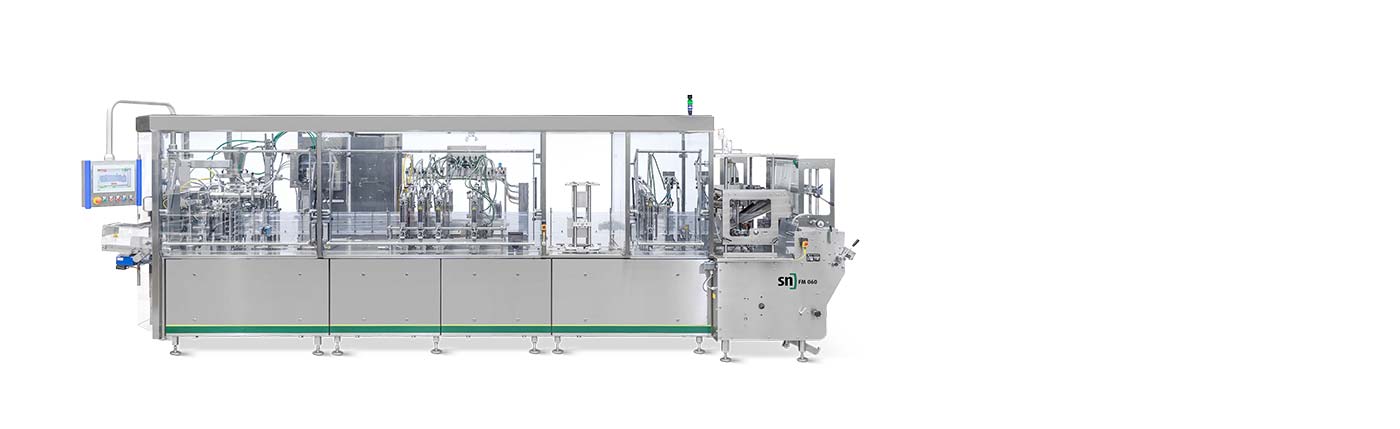
FM 060
Horizontal form, fill and seal machine (HFFS) duplex
Format range pouch width
40 – 100 mm
Format range pouch height
50 – 250 mm
Realistic output rate
up to 120 pouches/min.
Exemplary yearly production output (single shift)
about 12 million pouches
(Data dependent on filling properties, pouch size, and production times)
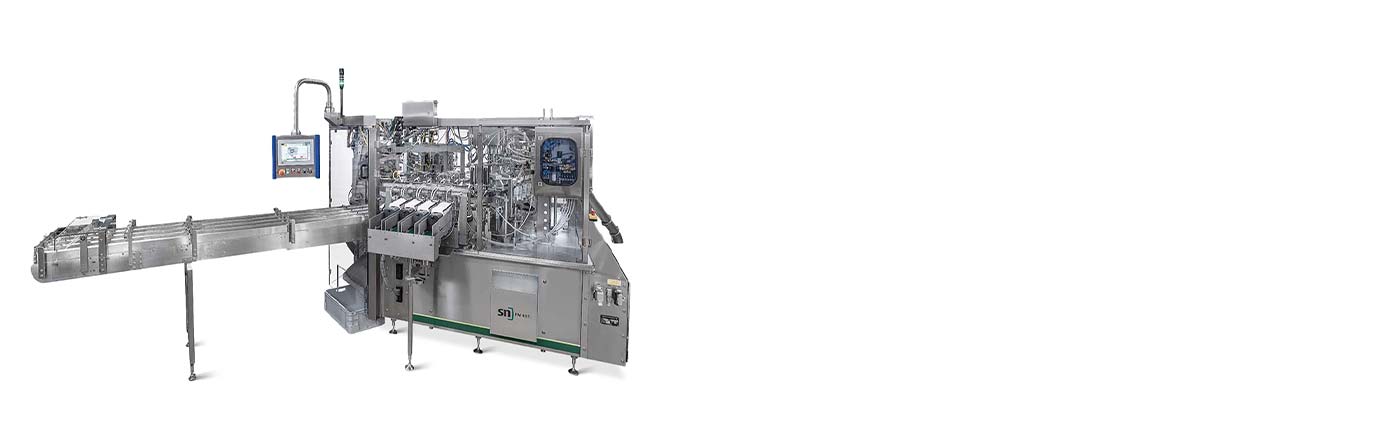
FM 415 FS
Horizontal fill and seal machine (HFS)
for pre-made pouches
Format range pouch width
70 – 93 mm
Format range pouch height
100 – 210 mm
Realistic output rate
up to 200 pouches/min.
Exemplary yearly production output (three shifts)
ca. 65 Mio. Beutel about 65 million pouches
(Data dependent on filling properties, pouch size, and production times)
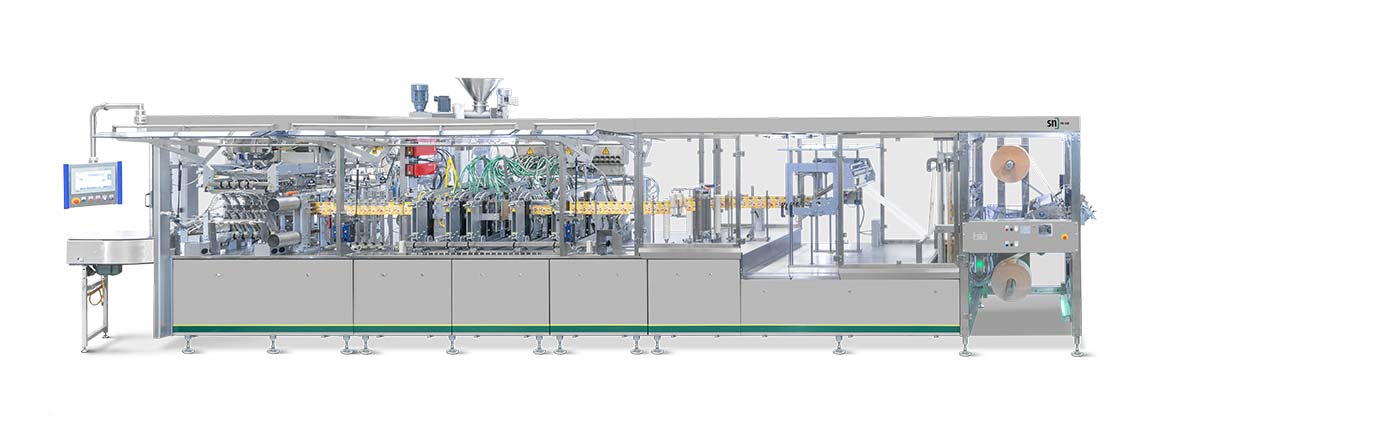
FM 500
Horizontal form, fill and seal machine (HFFS)
Format range pouch width
75 – 100 mm
Format range pouch height
90 – 210 mm
Realistic output rate
up to 300 pouches/min.
Exemplary yearly production output (three shifts)
about 95 million pouches
(Data dependent on filling properties, pouch size, and production times)

Contact
We are happy to support you in your pouch packaging project with customized machine and dosing technology.
We look forward to your inquiry.
Phone: +49 2267 699-0
Email: sales@sn-packaging.de